Table of Contents
Imagine standing at the starting line of a 100-mile trail race before dawn, the air crisp and the only light coming from your headlamp. Your watch isn’t just telling time; it’s your lifeline, your navigation system, and your performance coach rolled into one. For endurance athletes pushing beyond the marathon—ultra-runners, triathletes, and long-distance trailblazers—the right GPS running watch transcends being a mere gadget. It becomes an essential piece of gear, silently logging every kilometer, monitoring vital signs when you’re too fatigued to notice, and ensuring you don’t lose your way in remote terrain. The stakes are high, and the demands are unique; a device that falters during a 5-hour run simply won’t cut it when you’re out for 24+.
The landscape of running technology evolves rapidly, and what mattered in 2023 might be obsolete by 2026. Endurance-specific needs cut through the noise of flashy features aimed at casual users. You need unwavering reliability when satellite signals are weak under dense forest canopies, battery life that matches or exceeds your longest effort without needing a portable charger strapped to your waist, and physiological insights that help you avoid hitting the wall before the finish line. This guide cuts through the marketing hype to focus solely on the critical features and considerations that truly impact athletes logging extreme distances, empowering you to make an informed decision based on your specific endurance demands, not the latest trend.
Top 10 GPS Running Watches for Endurance Athletes
Detailed Product Reviews
1. Garmin Forerunner 55, GPS Running Watch with Daily Suggested Workouts, Up to 2 Weeks of Battery Life, Black - 010-02562-00

Overview:
The Garmin Forerunner 55 is an entry-level GPS running watch designed for beginners and casual runners seeking essential tracking without complexity. It delivers core metrics like pace, distance, and heart rate via wrist-based monitoring, alongside useful training tools and impressive battery longevity.
What Makes It Stand Out:
Its standout features include up to two weeks of battery life in smartwatch mode and daily suggested workouts tailored to your fitness level. The PacePro strategy tool aids race planning, while diverse built-in activity profiles (running, cycling, pool swim, HIIT) cater to cross-training. Bluetooth connectivity ensures seamless data sync.
Value for Money:
Priced mid-range, it offers exceptional value for new runners. While premium models like the Forerunner 255 provide advanced metrics, the 55 covers fundamentals reliably. Its battery life surpasses many competitors in this tier, making it cost-effective for consistent, low-maintenance use without frequent charging.
Strengths and Weaknesses:
Strengths: Outstanding battery life; intuitive interface; robust activity tracking; useful PacePro guidance; solid water resistance.
Weaknesses: Basic monochrome display; no music storage; limited recovery insights; heart rate accuracy lags behind optical sensors on pricier models.
Bottom Line:
Ideal for runners prioritizing simplicity and battery endurance over advanced analytics. It’s a highly accessible gateway into structured training, justifying its price for beginners seeking reliable, no-fuss performance.
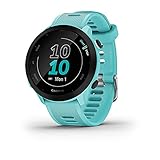
2. Garmin Forerunner 55, GPS Running Watch with Daily Suggested Workouts, Up to 2 Weeks of Battery Life, Aqua
Overview:
This aqua variant of the Garmin Forerunner 55 shares identical functionality with the black model but features a vibrant blue-gray bezel and band. It targets runners desiring essential GPS tracking, heart rate monitoring, and smart coaching in a stylish, water-ready package.
What Makes It Stand Out:
Beyond the aesthetic upgrade, it retains all core strengths: two-week battery life, PacePro race strategy, daily suggested workouts, and multi-sport profiles. The aqua finish offers subtle personality without compromising the watch’s durability or 50m water resistance, ideal for swimmers and outdoor enthusiasts.
Value for Money:
Priced identically to the black model, the aqua version provides no functional upgrades but appeals to style-conscious users. For runners wanting reliable entry-level tracking with visual flair, it matches competitors like the Coros Pace 2 on features but edges ahead with Garmin’s ecosystem reliability.
Strengths and Weaknesses:
Strengths: Same excellent battery life and training tools as black model; attractive color option; lightweight comfort; comprehensive sport modes.
Weaknesses: Display lacks color; no music or contactless payments; heart rate sensor less precise during high-intensity intervals; identical performance to cheaper black variant.
Bottom Line:
A cosmetic alternative to the standard Forerunner 55. Choose it only if the aqua design resonates; otherwise, the black model offers identical value. Still a top pick for beginner runners seeking dependable, long-lasting basics.
3. EZON GPS Running Watch with Distance Pace Alarm and Calorie Counter and Stopwatch for Men T031B01 Black

Overview:
The EZON T031B01 is a budget-focused GPS running watch targeting cost-conscious fitness enthusiasts. It emphasizes core tracking—distance, pace, calories—with manual data review and stopwatch functions, positioning itself as a no-frills alternative to premium brands.
What Makes It Stand Out:
Its cold/hot GPS start efficiency (1-minute cold start) and automatic time sync via GPS stand out for affordability. The personalized profile setup (height, weight, etc.) enhances calorie/distance accuracy, while lap tracking (50 laps saved) and stopwatch functionality cater to interval training on a tight budget.
Value for Money:
At a fraction of Garmin’s price, it delivers functional GPS tracking for casual runners. However, it lacks smart features (no Bluetooth/app sync) and advanced analytics. Worth considering only for basic outdoor tracking needs where budget is paramount, though durability concerns linger.
Strengths and Weaknesses:
Strengths: Very low cost; reliable GPS positioning; useful lap/stopwatch tools; personalized fitness metrics; 10-workout memory.
Weaknesses: No smartphone connectivity; basic monochrome screen; limited battery life details; no real-time coaching; build quality feels less robust than mid-tier competitors.
Bottom Line:
A barebones option for occasional runners prioritizing price over ecosystem integration. Avoid if you want app connectivity or training guidance; suitable only for straightforward distance/pace logging without frills.
4. mibro GS Active2 Running GPS Smartwatch with 46mm AMOLED, Lightweight and 15-Day Battery, Supports Training Guidance and Dual-Band GNSS, 150+ Sport Modes (Dark Gray)

Overview:
The Mibro Active2 is a mid-tier GPS smartwatch blending vibrant AMOLED display, dual-band GNSS accuracy, and extensive sport modes. It targets fitness enthusiasts seeking detailed running analytics, adaptive training plans, and long battery life in a lightweight package.
What Makes It Stand Out:
Its standout elements include a bright 46mm AMOLED screen, five-satellite dual-frequency positioning for urban canyon accuracy, and Mibro Coach adaptive training plans (5K to half-marathon). The 39g ultra-light design and 15-day battery life (15 hours GPS) enhance comfort during extended use.
Value for Money:
Priced below Garmin’s mid-range models, it offers comparable GPS precision and superior screen quality. While lacking some recovery metrics, its training guidance, navigation features, and marathon-tested battery life deliver strong value for serious recreational runners.
Strengths and Weaknesses:
Strengths: Stunning AMOLED display; exceptional lightweight comfort; highly accurate dual-band GNSS; adaptive race training; robust 15-day battery.
Weaknesses: Limited third-party app integration; VO₂ Max estimates less refined than Garmin; no music storage; app interface less polished than competitors.
Bottom Line:
An excellent value-driven choice for runners wanting premium display tech and reliable GPS without breaking the bank. Best for those prioritizing real-time guidance and comfort over deep ecosystem integration.
5. SUUNTO 9 Peak and Peak Pro Sports GPS Watch for Demanding, Performance Driven Athletes and Adventurers

Overview:
The Suunto 9 Peak Pro is a rugged, high-end GPS watch engineered for elite athletes and adventurers facing extreme conditions. It combines military-grade durability, multi-satellite precision, and rapid charging with advanced performance metrics for serious training and exploration.
What Makes It Stand Out:
Its Finnish craftsmanship (titanium/stainless steel, sapphire glass), 40-hour GPS battery (70h endurance mode), and 1-hour full charge set it apart. Four-satellite tracking ensures reliability in canyons/mountains, while features like weather alerts, avalanche maps, and 97 sport modes cater to technical adventurers.
Value for Money:
Positioned at a premium price, it justifies cost through uncompromising durability, specialized safety tools, and professional-grade analytics (VO₂ Max trends, recovery tracking). Outperforms mid-tier watches in harsh environments but may overwhelm casual users.
Strengths and Weaknesses:
Strengths: Exceptional build quality; best-in-class GPS accuracy; rapid charging; comprehensive safety features; deep training/recovery insights.
Weaknesses: Very high price point; complex for beginners; shorter GPS battery than Suunto’s own non-Pro models; limited smart features compared to Garmin.
Bottom Line:
The ultimate choice for professionals and adventurers needing bombproof reliability and advanced metrics in extreme conditions. Overkill for casual use, but unmatched for those demanding peak performance and safety in the wild.
6. Garmin Forerunner 55, GPS Running Watch with Daily Suggested Workouts, Up to 2 Weeks of Battery Life, White

Overview:
The Garmin Forerunner 55 is an entry-level GPS running watch designed for beginners and casual runners seeking essential tracking without complexity. It delivers core metrics like pace, distance, and heart rate via wrist-based monitoring (non-medical), alongside smartwatch functionality.
What Makes It Stand Out:
Its standout features include an impressive two-week battery life in smartwatch mode and intuitive daily suggested workouts that adapt to your recovery. The PacePro strategy tool aids race planning, while 20+ activity profiles (including Pilates and HIIT) broaden versatility beyond running. Bluetooth connectivity enables seamless smartphone pairing.
Value for Money:
Priced accessibly, the Forerunner 55 offers exceptional value for runners prioritizing reliability and Garmin’s trusted ecosystem over premium displays or advanced analytics. It undercuts pricier models while delivering dependable GPS tracking and critical training insights, making it ideal for budget-conscious newcomers.
Strengths and Weaknesses:
Strengths: Outstanding battery life; user-friendly interface; adaptive daily workouts; broad activity support; compact design.
Weaknesses: Basic monochrome display lacks AMOLED vibrancy; limited advanced metrics (e.g., no ground contact time); non-replaceable band; no music storage.
Bottom Line:
A superb first running watch that balances affordability, battery longevity, and foundational training tools. Recommended for runners seeking simplicity and Garmin’s reliability without advanced (or expensive) features.
7. COROS PACE 3 GPS Sport Watch - Lightweight, Comfortable Running Watch, 17-Day Battery Life, Accurate GPS, Heart Rate Monitor, Navigation, Sleep Tracking, Training Plan, Run, Bike - Black Silicone

Overview:
The COROS PACE 3 is an ultra-lightweight GPS sport watch targeting serious runners and multisport athletes. Its featherweight 30g design (with nylon band) and 11.7mm profile prioritize all-day comfort, while dual-frequency GPS ensures precision in challenging environments like urban canyons.
What Makes It Stand Out:
Dual-frequency GPS accuracy and exceptional endurance—38 hours in GPS mode or 24 days in smartwatch mode—set it apart. The transflective always-on touchscreen remains readable in sunlight, and breadcrumb navigation simplifies route adherence. Integrated route planning via the COROS app streamlines outdoor adventures.
Value for Money:
Competitively priced against mid-tier Garmins, the PACE 3 delivers superior battery life and cutting-edge GPS technology. It offers professional-grade tracking at a fraction of the cost of flagship models, making it a top value pick for endurance-focused athletes seeking reliability without overspending.
Strengths and Weaknesses:
Strengths: Industry-leading battery life; best-in-class GPS accuracy; featherlight comfort; intuitive navigation; robust route-planning tools.
Weaknesses: Smaller app ecosystem than Garmin; limited smart features (e.g., no call/music control); display less vibrant than AMOLED competitors.
Bottom Line:
An outstanding choice for runners prioritizing battery life, GPS precision, and minimalist comfort. Highly recommended for trail runners and marathoners needing dependable, long-lasting performance.
8. Garmin Forerunner 165, Running Smartwatch, Colorful AMOLED Display, Training Metrics and Recovery Insights, Black

Overview:
The Garmin Forerunner 165 elevates entry-level running with a vibrant AMOLED display and advanced training analytics. This 43mm smartwatch combines wrist-based heart rate monitoring, GPS tracking, and a hybrid button-touch interface in a lightweight package tailored for data-driven runners.
What Makes It Stand Out:
Its brilliant AMOLED screen—uncommon at this price point—and personalized daily suggested workouts via Garmin Coach are key highlights. The morning report consolidates sleep, recovery, and HRV status instantly upon waking, while adaptive training plans optimize race preparation based on real-time performance.
Value for Money:
Justifying its mid-range price, the 165 delivers premium aesthetics (AMOLED) and Garmin’s sophisticated coaching tools typically found in costlier models. It outperforms the Forerunner 55 with richer insights and a superior display, offering the best balance of innovation and affordability in Garmin’s entry lineup.
Strengths and Weaknesses:
Strengths: Stunning AMOLED display; comprehensive recovery/training insights; intuitive Garmin Coach integration; lightweight comfort; 25+ sport profiles.
Weaknesses: GPS battery life (19 hours) trails competitors; no music storage; limited third-party app support.
Bottom Line:
A compelling upgrade for runners wanting Garmin’s intelligence in a stylish, user-friendly package. Ideal for those valuing visual clarity and adaptive coaching over extreme battery endurance.
9. afoloery GPS Running Watch and Outdoor Smartwatch, AMOLED Display, Built-in LED Flashlight,Multisport GPS Smartwatch,5ATM Waterproof,Fitness Tracker up to 15 Days of Battery

Overview:
The afoloery GPS Running Watch is a feature-packed budget multisport tracker targeting outdoor enthusiasts. It promises AMOLED visuals, 100+ sport modes, and unique utilities like an LED flashlight, all wrapped in a 5ATM waterproof design for rugged adventures.
What Makes It Stand Out:
Dual-satellite GPS (GPS + BeiDou), the integrated LED flashlight, and 100+ sport modes—including specialized outdoor metrics like altimeter and compass—distinguish it. Seamless Google Fit/Apple Health sync and Bluetooth call answering offer smart convenience rarely seen at this price.
Value for Money:
Extremely cost-effective for casual users seeking maximum features per dollar. While lacking the polish of Garmin/COROS, its flashlight, broad sport support, and 15-day battery provide surprising utility for hiking, swimming, or basic fitness tracking on a tight budget.
Strengths and Weaknesses:
Strengths: Exceptional feature density; LED flashlight; 100+ sport modes; strong battery life; broad health monitoring (blood oxygen, HRV).
Weaknesses: Questionable GPS accuracy/reliability; build quality concerns (zinc alloy case); generic app experience; limited brand support.
Bottom Line:
A functional budget option for casual adventurers needing versatility over precision. Recommended only for non-competitive users prioritizing features like the flashlight over elite tracking accuracy.
10. Garmin Forerunner® 255, GPS Running Smartwatch, Advanced Insights, Long-Lasting Battery, Slate Gray

Overview:
The Garmin Forerunner 255 is a premium running smartwatch blending advanced performance analytics with daily lifestyle tracking. Available in 41mm/46mm sizes, it features an always-on color display, detailed recovery metrics, and robust GPS capabilities for dedicated athletes.
What Makes It Stand Out:
Its holistic health ecosystem shines: the morning report synthesizes sleep, HRV, and adaptive workouts, while 30-hour GPS battery life supports ultramarathons. Race-day tools like completion-time predictions and weekly adaptive training plans leverage weather and course data for precision.
Value for Money:
Positioned as a mid-to-high-tier investment, the 255 justifies its cost with Garmin’s most comprehensive training suite. It bridges the gap between entry-level models and flagships (e.g., Forerunner 955), offering 90% of elite features—like advanced running dynamics—at a more accessible price.
Strengths and Weaknesses:
Strengths: Unmatched training/recovery insights; exceptional battery longevity; adaptive race-day tools; bright always-on display; versatile sizing.
Weaknesses: No music storage in base model; expensive accessory bands; complex menu system for beginners.
Bottom Line:
The definitive choice for serious runners seeking data-driven performance gains without flagship costs. Highly recommended for athletes committed to optimizing training through deep, actionable analytics.
Core Endurance Performance Features
Extended Battery Life Beyond the Basics
For true endurance events, standard battery claims are meaningless. Look for devices offering real-world battery life specifically in GPS mode, often significantly less than manufacturer max claims. Consider watches with ultra-long battery modes that disable non-essential features (like always-on display or music storage) to prioritize core tracking. Solar charging capability, while not a full replacement for a large battery, can provide crucial top-ups during multi-day adventures or long trail races, extending operational time when access to power is impossible.
Multi-Band GNSS and Signal Reliability
Relying solely on basic GPS is a gamble in challenging environments. Multi-band GNSS technology (utilizing signals from multiple satellite constellations like GPS, GLONASS, Galileo, and BeiDou across different frequency bands) dramatically improves accuracy and signal lock, especially in canyons, dense forests, or urban areas with tall buildings. This is non-negotiable for trail ultras where precise navigation and accurate distance tracking are critical for safety and performance analysis. Look for watches that clearly specify multi-band support.
Advanced Route Navigation and Safety
Beyond simple breadcrumb trails, endurance-specific navigation requires detailed topo maps, the ability to pre-load complex routes with turn-by-turn cues, and robust offline mapping. Critical safety features include incident detection that can automatically alert emergency contacts if a fall is detected during your run, and integration with satellite communication systems (like SOS via connected services) for truly remote areas where cell service is absent. Route deviation alerts are also vital for staying on course during long, fatiguing efforts.
Physiological Monitoring for Long Hauls
Recovery Metrics Beyond Basic Sleep Tracking
Endurance athletes need deep insights into their readiness to handle massive training loads. Look for watches providing detailed analysis of Heart Rate Variability (HRV), tracked consistently over time, alongside comprehensive sleep staging (not just duration). Advanced recovery scores that factor in training history, HRV trends, sleep quality, and even stress indicators offer a more holistic picture of whether you’re primed for a hard effort or need rest, crucial for avoiding overtraining syndrome.
Real-Time Performance Management Tools
During long efforts, real-time feedback is key to pacing and avoiding disaster. Features like PacePro™ (or similar adaptive pacing profiles based on elevation and course data) help maintain consistent effort on hilly terrain. Real-time Stamina metrics estimate remaining energy reserves based on current pace, heart rate, and historical data. Elevation Profile displays showing upcoming climbs and descents allow for proactive energy management, preventing burnout on long ascents or unnecessary fatigue on descents.
Long-Term Training Load and Injury Prevention
The watch should track chronic and acute training load, providing insights into your fitness versus fatigue balance (often visualized as a Training Stress Balance). Advanced metrics analyzing running dynamics (like vertical oscillation, ground contact time balance, and stride length) over extended periods can identify subtle form changes that might indicate developing imbalances or injury risks before they become debilitating. Consistent, accurate data collection here is paramount.
Durability and Practical Endurance Design
Ruggedized Construction for Harsh Conditions
Endurance events mean exposure to relentless elements: mud, rain, dust, extreme temperatures, and constant impacts. Watches must boast high water resistance ratings (100m minimum, preferably 100m+ with WR100 specifications), military-grade durability standards (like MIL-STD-810), and scratch-resistant sapphire or reinforced glass. The band material needs to withstand sweat, chafing, and prolonged wear without degrading or causing irritation during multi-day efforts.
Optimized Display Visibility in All Light
An unreadable screen during a crucial moment is dangerous. Transflective memory-in-pixel (MIP) displays remain highly visible in direct, bright sunlight without excessive power drain, unlike standard LCDs or OLEDs that struggle or max out brightness. Ensure the display is large enough to read key metrics at a glance while fatigued, and that customizable data screens allow prioritizing the most critical information for your effort (pace, elevation, battery, navigation cues).
Weight and Comfort for 24+ Hours
Every gram counts when worn for days. While durability is key, excessive weight becomes a significant burden. Look for watches utilizing lightweight yet strong materials like fiber-reinforced polymers or titanium bezels. The overall design should be low-profile to avoid snagging on clothing or vegetation. Comfort during extended wear, especially when the wrist swells during long efforts, is essential – consider band adjustability and hypoallergenic materials.
Data Integration and User Experience
Seamless Multi-Platform Ecosystem
Your watch data is only as useful as your ability to analyze it. Ensure robust, reliable syncing with major training platforms (like Strava, TrainingPeaks, or Golden Cheetah) that endurance athletes rely on for detailed analysis. The companion app itself should provide deep, actionable insights beyond simple graphs, offering trend analysis, comparative performance data, and integration with other health metrics for a holistic view.
Intuitive Interface Under Fatigue
When you’re exhausted at mile 80, complex menu navigation is unacceptable. The user interface must be intuitive, with physical buttons (often preferred over touchscreens in wet/muddy conditions) that are easy to operate with cold or gloved hands. Customizable quick-access menus and straightforward route management (loading, following, skipping cues) are critical usability factors that impact safety and performance during long events.
Battery-Smart Connectivity Options
While features like music storage or smart notifications are nice, they drain battery life rapidly. Prioritize watches that offer granular control over connectivity – easily disabling Wi-Fi, Bluetooth (except to essential sensors), and notifications when embarking on long efforts. The ability to quickly switch into a dedicated ultra-marathon mode that maximizes battery for core tracking functions is invaluable.
Sensor Compatibility and Accuracy
Reliable data starts with accurate sensors. Ensure compatibility with external sensors you rely on, such as foot pods for precise indoor/canopy-covered distance, chest straps for the most accurate heart rate monitoring during variable efforts, or bike power meters for triathletes. The accuracy of the built-in optical heart rate sensor, especially during rapid heart rate changes common in trail running, should be well-regarded within the endurance community.
Post-Event Analysis Depth
The true value emerges after the run. Look for platforms offering advanced post-race analysis: detailed elevation profiles overlaid with pace and heart rate, segment comparisons against previous efforts on the same course, comprehensive recovery timelines, and the ability to easily share critical route data with coaches or training partners. This depth is crucial for learning and improving performance cycle after cycle.
Future-Proofing Your Investment
Software Update Longevity and Roadmap
Endurance athletes keep gear for years. Research the manufacturer’s track record for providing meaningful, long-term software updates that add features, improve accuracy, or extend battery life. A watch with a strong update history signals a better long-term investment than one reliant solely on initial hardware specs. Check community forums for insights into update frequency and support duration.
Repairability and Service Options
Given the investment and critical nature of the device, consider repairability. Are batteries user-replaceable (or easily serviced)? Does the manufacturer offer affordable repair programs for screens or casings damaged during rugged use? Knowing support exists for physical repairs extends the usable life far beyond the warranty period, a significant factor for cost-conscious endurance athletes.
Frequently Asked Questions
How critical is multi-band GNSS for trail running versus road ultras?
Multi-band GNSS is significantly more critical for trail running due to frequent signal obstruction from tree cover, canyons, and mountains. While beneficial for road ultras in urban areas, basic GNSS is often sufficient on open roads; trail runners absolutely need multi-band for reliable, accurate tracking in challenging terrain.
Can solar charging realistically extend battery life enough for a 100-mile race?
Solar charging can provide a meaningful extension, typically adding 10-30% extra battery life under sustained strong sunlight. While unlikely to double runtime, it can be the crucial difference between your watch dying at mile 90 versus finishing strong, especially when combined with strategic power-saving modes.
Is an optical HR sensor accurate enough for pacing during long efforts, or is a chest strap necessary?
Optical sensors have improved significantly but can still lag or become erratic during rapid heart rate changes common in technical trail running or steep climbs. For the most accurate real-time pacing data crucial in endurance events, especially under variable conditions, a chest strap remains the gold standard for reliability.
What battery life specification should I prioritize for a 24-hour event?
Look for real-world tested battery life in GPS mode, specifically under conditions mimicking your event (e.g., multi-band GNSS, music off, notifications off). Manufacturer max claims are often unrealistic. Aim for a watch proven to deliver 30+ hours in demanding GPS mode for a true 24-hour safety margin.
How important is HRV for someone new to ultra-running?
HRV is highly valuable for all ultra-runners, including beginners. It provides an objective measure of recovery stress that isn’t always perceptible. Monitoring HRV trends helps prevent overtraining early on, which is critical when significantly increasing training volume for ultra-distances, reducing injury risk.
Do I need satellite communication (SOS) built-in, or is a connected smartphone sufficient?
For remote trail ultras or unsupported races far from cell coverage, built-in satellite communication (SOS) is strongly recommended as a safety net when your phone might be dead or out of range. For road races or supported trail events near civilization, a charged phone is often adequate, but satellite SOS adds significant safety for wilderness adventures.
How do I evaluate the accuracy of a watch’s battery life claims?
Seek independent, long-term reviews from endurance athletes who’ve tested the watch on multi-hour efforts similar to your goals. Manufacturer claims are usually best-case scenarios. Real-world tests under heavy GPS use, with multi-band GNSS, provide the most reliable benchmark for actual endurance performance.
Are advanced running dynamics metrics (like ground contact time) useful for ultra-runners?
Yes, but primarily for long-term analysis, not real-time use. Tracking trends in dynamics over months can reveal developing inefficiencies or asymmetries that might lead to injury during high-mileage training. Focus on consistency and trends rather than minute-to-minute fluctuations during a race.
What’s the biggest usability mistake endurance athletes make with their GPS watches?
Overcomplicating data screens or relying too heavily on non-essential features (like constant music playback or smart notifications) during the event. Simplicity is key: customize screens to show only critical metrics (pace, elevation, battery, navigation) and disable all power-draining extras before starting a long effort.
How often should I replace my GPS running watch as an endurance athlete?
Focus on functionality and support, not arbitrary timelines. Replace when battery degradation significantly impacts long efforts (e.g., holds less than 50% of original capacity), critical features break, software updates cease leaving the device vulnerable or obsolete, or newer models offer substantial, relevant advancements (like vastly improved multi-band accuracy or essential safety features) that impact your core needs. Many quality watches serve endurance athletes reliably for 4-6 years with proper care.
See Also
- 10 Expert-Recommended GPS Running Watches for Ultramarathons in 2026
- 10 Expert-Recommended Running Watches for Ultramarathon Preparation in 2026
- Best GPS Running Watches for Beginners: 10 Expert Picks for 2026
- Best GPS Running Watches for Ultramarathoners: 10 Expert Picks for 2026
- Best GPS Running Watches for Triathletes: 10 Expert Picks for 2026