Table of Contents
Parents today face a constant tug-of-war: the undeniable need to connect with their children versus the deep concern about excessive screen time and mindless scrolling. It’s a modern parenting paradox. We want our kids to benefit from technology’s educational potential, yet we dread handing over devices that offer nothing but endless entertainment loops. Enter the evolving world of children’s wearables – specifically smartwatches designed not just for safety, but as genuine catalysts for curiosity and learning. Forget the outdated notion of kids’ watches as simple step counters or basic communicators; the next generation is poised to become a subtle, wrist-worn extension of the classroom and the world beyond.
Imagine a device that transforms a walk in the park into a spontaneous biology lesson, turns waiting time into vocabulary building, or helps a child visualize math concepts through interactive challenges – all without the distraction of social media feeds or addictive games. This isn’t science fiction for 2026; it’s the rapidly advancing reality of educational smartwatches tailored for young, inquisitive minds. These aren’t replacements for traditional learning, but powerful companions that seamlessly integrate knowledge acquisition into daily life, fostering a love for discovery in ways static textbooks simply cannot. Choosing the right one requires understanding the unique blend of safety, engagement, and age-appropriate pedagogy that defines this new category.
Top 10 Educational Smartwatches for Kids
Detailed Product Reviews
1. cjc HD Touchscreen Smartwatch for Girls Ages 4-12 - Includes 28 Games, Camera, Music, Pedometer - Fun & Educational Birthday Gift Idea (Purple)

Overview: This vibrant purple smartwatch targets girls aged 4-12 with a focus on fun and foundational learning. It combines a 1.83-inch HD touchscreen, educational games, and practical features like a camera and pedometer in a durable aluminum-frame design, positioning itself as an all-in-one toy and developmental tool.
What Makes It Stand Out: The woven strap and necklace lanyard replace stiff plastic bands for superior comfort and all-day wearability. With 28 built-in educational games, HD photo/video capabilities (including pop-up stickers), and a robust 500mAh battery offering seven-day life, it eliminates app/SIM dependencies while encouraging creativity and habit tracking.
Value for Money: Priced competitively against basic kids’ watches, it delivers exceptional breadth—audiobooks, voice recording, and a flashlight justify the cost. Though camera resolution lags behind premium devices, the inclusion of 28 games and extended battery life provides more utility than cheaper alternatives under $40.
Strengths and Weaknesses: Strengths: Comfortable strap design; extensive feature set (28 games, MP3 player); impressive battery longevity; easy USB charging. Weaknesses: Camera quality is adequate but not exceptional; limited to preset functions with no expandability; purple color may not appeal universally.
Bottom Line: An excellent, well-rounded gift for fostering creativity and basic digital literacy. Its comfort, educational value, and seven-day battery make it a top pick for parents seeking screen time with purpose.
2. Smart Watch for Kids with 26 Puzzle Games, HD Touch Screen Kids Watch, Camera, Music Player, Alarm Clock, Calculator, Pedometer, Learn Card - 12/24hr Toys for Age 3-12 Year Old, Birthday Gift for Boys

Overview: Designed for ages 3-12, this unisex smartwatch emphasizes education through 26 puzzle games, a 300K-pixel camera, and learning tools like 104 digital flashcards. It operates independently—no apps or SIM cards needed—making it accessible for young children seeking both entertainment and skill development.
What Makes It Stand Out: Parental controls for game time limits prevent overuse, while 10 audiobooks and 104 learning cards directly target literacy and cognitive growth. The 13-alarm clock feature uniquely builds time-management skills, and its 10,000+ photo storage capacity outperforms competitors in memory.
Value for Money: At mid-tier pricing, it excels as an educational investment. The inclusion of structured learning tools (audiobooks, flashcards) surpasses simpler game-focused watches, though camera resolution is modest. Better value than pricier smartwatches lacking its pedagogical focus.
Strengths and Weaknesses: Strengths: Strong educational suite; robust parental controls; generous storage; USB music loading. Weaknesses: Battery life (3–7 days) is average; camera quality is functional but blurry; limited to basic functions like calculator/stopwatch.
Bottom Line: Highly recommended for parents prioritizing learning over connectivity. Its thoughtful educational tools and usage controls make it a practical, screen-time-smart choice for preschoolers to pre-teens.
3. Smart Watch for Kids, 1.54" HD Touchscreen Watches with 26 Games, Camera, Video Recorder, Music, Pedometer, Alarm Clock Calendaring, Flashlight, IP67 Waterproof Birthday Toys for 3-12 Years Old Kids

Overview: This versatile watch blends play and wellness with 26 educational games, IP67 waterproofing, and activity tracking. Tailored for ages 3–12, it avoids distractions (no calls/SIM) while offering HD photography, audiobooks, and pedometer-driven health incentives in a kid-friendly 1.54-inch touchscreen format.
What Makes It Stand Out: IP67 waterproofing allows worry-free use in rain or spills—a rarity in this category. USB-C charging (2-hour full charge) and 420mAh battery ensure reliability, while pedometer integration with three exercise modes (dancing, skipping) actively promotes physical activity beyond basic step counting.
Value for Money: Justifies its price with premium durability and modern USB-C. Outperforms non-waterproof rivals in longevity, and the activity-tracking focus adds health value missing in game-heavy alternatives. Slightly costlier but worthwhile for active families.
Strengths and Weaknesses: Strengths: IP67 waterproofing; USB-C convenience; exercise-mode pedometer; distraction-free design. Weaknesses: Camera lacks advanced features; battery life (3–7 days) varies significantly with usage; no expandable storage.
Bottom Line: Ideal for outdoorsy kids needing a resilient, health-focused device. Its waterproof build and activity tools make it a standout for parents seeking durable, purpose-driven tech over flashy extras.
4. BEIARA Kids Smart Watch for Girls with 32 Games Audiobook Learn Card HD Touchscreen Camera Music Player Pedometer Educational Toys Birthday Gift for Kids Girls Ages 4-12 Kids Smartwatch

Overview: Targeting girls 4–12, this watch features 32 preloaded games, audiobooks, and a pedometer with three exercise modes (dancing, skipping, running). Its 1.54-inch touchscreen and camera prioritize creativity, positioning itself as an educational gift that blends play with light physical activity tracking.
What Makes It Stand Out: The triple-mode pedometer (running, skipping, dancing) uniquely encourages diverse movement, while 10 storybooks and 100 letter-learning cards deepen literacy engagement. The immediate usability—zero app/SIM setup—makes it exceptionally parent-friendly for young users.
Value for Money: Competitive at entry-level pricing, it offers more games (32) than most rivals. The learning-card library provides tangible educational ROI, though camera specs are basic. Better value than watches with fewer educational tools at similar price points.
Strengths and Weaknesses: Strengths: Diverse exercise tracking; rich literacy content; plug-and-play simplicity; vibrant kid-designed wallpapers. Weaknesses: Camera quality is entry-level; battery life unspecified beyond “rechargeable”; limited to preset features.
Bottom Line: A solid choice for fostering movement and reading skills. While not the most feature-dense, its focus on accessible education and activity makes it a reliable, fuss-free gift for younger children.
5. Kids Smart Watch Gift for Girls Age 5-12, 39 Games HD Touch Screen Watches with Video Camera Music Player Pedometer Flashlight 12/24 hr Educational Toys Birthday Gifts for Girls Ages 7 8 9 10

Overview: This watch targets girls 5–12 with an emphasis on expansive gameplay (39 games) and habit-building tools. It includes HD photography, music playback, and a unique habit tracker, all wrapped in an aluminum-frame design with a 1.54-inch touchscreen for intuitive use.
What Makes It Stand Out: Boasting the highest game count (39) in this lineup, it sharpens logic and coordination through varied puzzles. The standout habit tracker cultivates routines like brushing teeth, while the 500mAh battery promises seven-day longevity—surpassing most competitors’ 3–5 day claims.
Value for Money: Premium-priced but justified by volume: 39 games and habit features exceed typical offerings. The aluminum build adds durability, though the camera lacks innovation. Worth the splurge for parents seeking extended engagement over basic alternatives.
Strengths and Weaknesses: Strengths: Unmatched game variety; effective habit tracker; industry-leading battery life; sturdy aluminum frame. Weaknesses: Camera specs generic; “girls-focused” branding may limit appeal; no waterproofing.
Bottom Line: Best for older kids craving diverse challenges. Its habit-building focus and exceptional battery make it a top-tier pick for parents wanting screen time that actively supports development.
6. PlayZoom 4 Kids Smartwatch, Educational Tech Toy – 25+ Games, Selfie Camera, Audiobooks, Step Tracker, Water‑Resistant, Parental Controls, Long Battery, Ages 4‑12 (Pink Donuts)

Overview:
The PlayZoom 4 Kids Smartwatch is a versatile educational tech toy designed for children aged 4–12, blending entertainment with learning. Its 1.83” color touchscreen, water-resistant build, and focus on screen-free activities make it a practical first device for young users.
What Makes It Stand Out:
Preloaded STEM games requiring no Wi-Fi, 10 audiobooks, and sing-along songs encourage cognitive development without internet dependency. Parental controls and water resistance add safety, while the step tracker promotes physical activity—unlike many competitors, it avoids ads and in-app purchases.
Value for Money:
Priced mid-range for kids’ smartwatches, it justifies cost through robust parental safeguards and diverse offline content. Cheaper models lack water resistance and curated educational content, while premium alternatives often require subscriptions for similar features.
Strengths and Weaknesses:
Strengths: Reliable battery life; intuitive parental controls; balanced screen/audio activities; durable for active kids.
Weaknesses: Camera quality is basic; limited game variety after initial use; no GPS tracking for safety.
Bottom Line:
Ideal for parents prioritizing educational value and safety over advanced tech. Its focus on offline learning and movement makes it a worthwhile investment for fostering healthy habits in young children.
7. Cosjoype Kids Game Smart Watch for Kids with 39 Puzzle Games HD Touch Screen Camera Music Player Pedometer Alarm Clock Calculator Flashlight 12/24hr Kid Watch Gift for 4-12 Year Old Boys Toys for Kid

Overview:
The Cosjoype Kids Game Smart Watch packs 39 puzzle games and 20+ functions into a vibrant aluminum-frame device targeting 4–12-year-olds. It emphasizes logic development and multifunctionality as an all-in-one entertainment tool.
What Makes It Stand Out:
Its sheer feature count—video recording, flashlight, habit tracker, and multilingual support—exceeds most rivals. The pop sticker camera and step/calorie tracking add playful engagement, while the 1.54” HD screen ensures kid-friendly usability.
Value for Money:
Competitively priced for its breadth, it offers better utility than single-purpose watches. However, some features (e.g., video recording) are gimmicky; alternatives like PlayZoom provide more cohesive educational value at similar prices.
Strengths and Weaknesses:
Strengths: Extensive game library; durable aluminum build; useful tools (calculator, flashlight); strong step-tracking motivation.
Weaknesses: Overwhelming interface for younger kids; battery drains quickly with video use; no parental controls or water resistance.
Bottom Line:
Best for kids seeking pure entertainment over structured learning. While feature-rich, its lack of safety controls limits appeal for cautious parents—opt for PlayZoom if education is the priority.
8. PlayZoom 4 Kids Smartwatch, Educational Tech Toy – 25+ Games, Selfie Camera, Audiobooks, Step Tracker, Water‑Resistant, Parental Controls, Long Battery, Ages 4‑12 (Black Space)

Overview:
Identical in specs to Product #6 but styled in Black Space, this PlayZoom Smartwatch delivers the same educational focus for kids 4–12. Its space-themed design appeals to older children while retaining core learning and safety features.
What Makes It Stand Out:
The standout remains its ad-free, Wi-Fi-free ecosystem: 25+ STEM games, step tracking, and parental controls prioritize development over distraction. Water resistance and long battery life enhance practicality for daily use, unlike flashier but less secure competitors.
Value for Money:
Matches Product #6’s value proposition—justifying its price through curated content and durability. Cheaper watches (e.g., basic DERUI models) lack parental controls, while rivals like Cosjoype overload features without educational depth.
Strengths and Weaknesses:
Strengths: Consistent educational content; robust parental oversight; excellent battery longevity; gender-neutral design.
Weaknesses: Camera resolution is low; game replay value diminishes; no GPS for location tracking.
Bottom Line:
A top choice for parents wanting a safe, screen-balanced tech toy. The Black Space variant’s mature aesthetic suits older kids, making it a reliable upgrade from purely entertainment-focused alternatives.
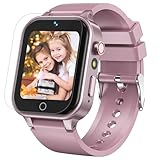
9. DERUI 1.5 Inches Kids Smart Watch for Boys Girls, 26 Puzzle Games, Smartwatch with Camera, Pedometer, Video Voice Music Player Learning Card, Birthday Gift for 3-12 Years Children (Pink)
Overview:
The DERUI Kids Smart Watch targets ages 3–12 with a 1.5” touchscreen, 26 puzzle games, and multimedia features. It positions itself as an affordable entry-level smartwatch emphasizing cognitive development through puzzles.
What Makes It Stand Out:
Its 500mAh battery offers 3–7 days of use per charge—a standout for longevity. The “learning card” feature and video/music player provide varied engagement, though it lacks critical safety elements like water resistance or robust parental controls.
Value for Money:
Budget-friendly, but compromises exist. It undercuts PlayZoom by $15–20, yet missing water resistance and ad-free content reduces long-term value. Ideal for casual use, but not for active kids or safety-conscious parents.
Strengths and Weaknesses:
Strengths: Exceptional battery life; affordable; simple puzzle games boost logic skills; video recording capability.
Weaknesses: No parental controls or water resistance; screen smaller than rivals; games feel repetitive; build quality less durable.
Bottom Line:
A decent starter watch for limited use, but its safety gaps make it hard to recommend over PlayZoom. Best for budget-focused buyers who prioritize battery life over holistic child safety.
10. PlayZoom 4 Kids Smartwatch, Educational Tech Toy – 25+ Games, Selfie Camera, Audiobooks, Step Tracker, Water‑Resistant, Parental Controls, Long Battery, Ages 4‑12 (Fuchsia Pink)

Overview:
The Fuchsia Pink PlayZoom Smartwatch mirrors Products #6 and #8 with identical features but a vibrant color option. Designed for 4–12-year-olds, it champions education-first tech with no internet dependency.
What Makes It Stand Out:
Its gender-inclusive Fuchsia Pink design broadens appeal, while core strengths—Wi-Fi-free STEM games, parental controls, and step tracking—remain unmatched in safety and educational focus. The 10 audiobooks enable valuable screen-free downtime.
Value for Money:
Priced consistently across PlayZoom variants, it offers superior value through holistic development tools. Competitors either skimp on safety (Cosjoype) or lack content depth (DERUI), making this a balanced investment.
Strengths and Weaknesses:
Strengths: Trusted parental safeguards; durable water-resistant build; promotes physical activity; engaging offline content.
Weaknesses: Camera quality underwhelming; limited game updates; color variant doesn’t add functional benefits.
Bottom Line:
The Fuchsia Pink model is perfect for parents seeking a safe, educational device with broad age appeal. Despite minor flaws, its commitment to child development solidifies it as a top-tier choice in the kids’ smartwatch market.
Understanding the Educational Smartwatch Evolution
The children’s smartwatch market has moved far beyond basic calling and step tracking. Today’s educational focus represents a significant shift towards intentional design aimed at cognitive development and curiosity.
Beyond Step Counting: Purpose-Driven Features
Modern devices integrate features specifically engineered to stimulate learning. Think interactive quizzes triggered by location (like identifying local flora in a park), language translation tools for real-world encounters, or math puzzles solved through physical movement. The emphasis is on contextual learning – connecting digital prompts to the child’s immediate environment, making knowledge feel relevant and immediate, not abstract.
The Shift from Passive to Active Engagement
Gone are the days of watches that merely display information. The 2026 landscape prioritizes interactivity. This means voice-activated learning prompts, gesture-based responses to educational challenges, and collaborative features where kids can safely share discoveries with peers (like comparing weather data from different locations). Passive consumption is replaced by active participation, fostering critical thinking and problem-solving skills right on the wrist.
Integrating with Broader Learning Ecosystems
Forward-thinking designs consider how the watch fits into a child’s overall educational journey. Look for potential (even if nascent in 2026) for secure, limited integration with school platforms or educational apps used at home. This could mean syncing progress on vocabulary challenges or receiving curated, age-appropriate learning nuggets aligned with classroom topics, creating a more cohesive learning experience across different settings.
Essential Safety and Privacy Foundations
Before any educational feature takes precedence, robust safety and uncompromising privacy are non-negotiable pillars for any child’s wearable. Parents must prioritize these fundamentals above all else.
Military-Grade Security Protocols
Given the sensitive nature of tracking a child’s location and communication, top-tier devices employ encryption standards typically seen in high-security applications. This includes end-to-end encryption for all messages and calls, secure boot processes to prevent malware injection, and regular, seamless over-the-air security updates. The watch should be a fortress, not a vulnerability.
Granular Location Sharing Controls
Precise location tracking is essential, but control over who sees that location is paramount. Look for watches offering highly customizable geofencing (with safe zone alerts), the ability to share location only with pre-approved contacts for a limited, specific duration (e.g., just while walking home from soccer practice), and clear visual indicators showing when location sharing is active. Parents need absolute command over this critical data.
Strict Data Minimization and Transparency
Reputable manufacturers adhere to strict data minimization principles. This means collecting only the data absolutely necessary for core functionality (like location for safety, basic usage stats for feature improvement), anonymizing it wherever possible, and providing crystal-clear, jargon-free privacy policies. Parents should easily understand what data is stored, where it’s stored (ideally on-device or in highly secure, compliant regions), and how long it’s retained – with straightforward options to delete it.
Age-Appropriate Design and Functionality
A watch perfect for a 6-year-old exploring numbers will overwhelm an 8-year-old focused on creative writing, and vice versa. Matching features to developmental stages is crucial for genuine educational value and sustained engagement.
Early Learners (Ages 4-7): Simplicity and Sensory Engagement
For the youngest users, interfaces must be incredibly intuitive, often relying on large icons, voice commands, and minimal text. Educational content should focus on foundational skills: recognizing shapes and colors in the environment via the camera (with heavy parental control), simple phonics games triggered by voice, counting steps or objects, and basic emotional recognition prompts. Durability and battery life are extra critical here, as is avoiding complex menus.
Emerging Readers and Thinkers (Ages 8-10): Building Skills and Independence
This group thrives on slightly more complex challenges that build confidence. Features like interactive spelling bees using voice input, simple math problem-solving tied to real-world scenarios (e.g., calculating walking distance), introductory coding logic games, and safe, moderated ways to share creative drawings or facts with family become valuable. Parental controls should allow more autonomy within strictly defined boundaries, fostering responsible use.
Pre-Teens (Ages 11-13): Critical Thinking and Real-World Application
Older kids need tools that support deeper learning and practical application. Look for advanced language learning features (like contextual phrase translation), data visualization tools (graphing step count trends), research aids (safe, filtered web lookups for school projects), and collaborative problem-solving challenges. Privacy settings become more sophisticated, allowing controlled social features while maintaining strict safety protocols. The focus shifts towards tools that augment their growing academic responsibilities.
Avoiding Feature Overload for Younger Children
It’s tempting to buy a watch “they can grow into,” but overwhelming a young child with complex educational apps or communication features leads to frustration and disuse. Prioritize devices where core educational functions are simple, immediate, and directly tied to activities they already enjoy. A watch saturated with advanced features they can’t access or understand diminishes the user experience and safety focus.
Mastering Parental Control and Management
True peace of mind and effective educational integration hinge on intuitive, comprehensive parental controls that are easy to manage without becoming a full-time job.
The Centralized Parent Hub: Your Command Center
The companion parent app is arguably as important as the watch itself. It needs to be exceptionally well-designed on smartphones, offering a single, clear dashboard for managing all aspects: location tracking, educational content settings, communication permissions, screen time limits, and safety alerts. Cluttered or confusing apps defeat the purpose of having control.
Customizing the Learning Journey
Advanced parental controls allow tailoring the educational experience. This could mean enabling specific learning modules (e.g., focusing on Spanish vocabulary this month, disabling math games during summer break), setting time limits for educational apps specifically (separate from communication limits), and reviewing progress reports on completed challenges or time spent on learning activities. Parents become co-pilots in the learning process.
Setting Healthy Digital Boundaries
Beyond safety, effective controls help establish healthy tech habits. Look for nuanced scheduling: “Learning Mode” only during after-school hours, complete communication blackouts during homework time or bedtime, and automatic dimming or grayscale displays after a set period of continuous use. The ability to set different rules for weekdays vs. weekends or school days vs. holidays is essential for realistic integration into family life.
Durability, Comfort, and Practical Considerations
No matter how brilliant the educational features, a watch that breaks after a week, irritates the skin, or dies before lunchtime is useless. Practicality is paramount for daily wear by active children.
Built for the Real World: Ruggedness Matters
“Kid-proof” needs to mean something substantial. Expect reinforced corners, shatter-resistant screens (ideally mineral glass, not just plastic), and waterproofing rated for swimming (5 ATM or higher), not just splashes. The band material should be hypoallergenic silicone, easily cleanable, and feature secure, non-pinch clasps. Drop tests from reasonable heights (3-4 feet) should be a standard expectation, not a bonus.
All-Day Comfort for All-Day Wear
A watch that’s annoying to wear won’t be worn, negating all its benefits. Lightweight construction is key. Bands need to be adjustable for small wrists but also grow slightly with the child. The watch face should sit flat without digging in, and materials should breathe to prevent sweat irritation during play. Consider quick-swap bands for style or hygiene.
Battery Life Realities: Matching Usage Patterns
Honest battery life estimates are crucial. While some watches boast 2-day claims, real-world usage with GPS tracking, educational app use, and notifications often cuts that significantly. For most school-aged kids, a minimum of 1.5 full days (including a school day and evening) on a single charge is realistic. Fast charging (e.g., 80% in 30 minutes) is a major plus for busy families. Avoid watches needing daily charging if the child’s routine makes that difficult.
Evaluating Educational Content Quality
Not all “educational” features are created equal. Discerning truly valuable learning tools from gimmicks requires careful scrutiny of the content philosophy and execution.
Curriculum-Aligned vs. Fun-First Approaches
High-quality educational watches often collaborate with educators or reference established learning frameworks (like Common Core basics or Montessori principles). The best strike a balance: the core mechanics are the learning (e.g., solving a puzzle is the math problem), not just a reward after completing an unrelated task. Look for depth over breadth – a few well-designed, progressively challenging modules are better than dozens of shallow mini-games.
Adaptive Learning Capabilities
The most advanced systems incorporate subtle adaptivity. Does the difficulty of math challenges adjust based on the child’s success rate? Does the vocabulary builder introduce new words based on ones they’ve recently mastered? While full AI tutors on a watch are unlikely by 2026, basic progression systems that prevent frustration (by not making things too hard too fast) or boredom (by increasing challenge) significantly boost long-term educational value.
Offline Functionality is Non-Negotiable
Reliance on constant Bluetooth tethering to a parent’s phone or unstable Wi-Fi renders many educational features useless during walks, commutes, or school hours (where phone use is restricted). Essential learning tools – core quizzes, language builders, basic reference info – must function reliably in offline mode, syncing progress once connectivity is restored. A watch that only “teaches” when near a phone misses the point of mobile learning.
Future-Proofing Your Investment
Technology evolves rapidly. Choosing a device with longevity in mind saves money and reduces e-waste, especially for expensive educational tools.
Modular Software Updates
Prioritize brands with a proven track record of long-term software support. The ability to receive significant feature updates (like new educational modules or improved safety protocols) for 2-3 years after purchase is invaluable. Check the manufacturer’s update history for previous models – do they provide sustained support, or abandon devices quickly?
Hardware That Supports Tomorrow’s Needs
Consider hardware specs beyond the basics. Slightly more processing power or memory might seem unnecessary now but could enable more sophisticated educational apps released later. A better microphone supports future voice interaction advancements, and a higher-resolution screen ensures new learning content displays clearly. It’s about balanced future readiness, not over-spec’ing.
Ecosystem Considerations (Use with Caution)
While avoiding brand lock-in, some level of ecosystem compatibility can be beneficial. If your family heavily uses a specific educational platform (like certain school systems might), check if any future watches offer potential integration pathways. However, never prioritize this over core safety, privacy, and educational quality – it’s a minor secondary factor at best for 2026 devices.
Making the Final Decision: Your Family’s Priorities
With so many factors, the “best” watch is deeply personal. It hinges entirely on your child’s specific needs, your family’s lifestyle, and your non-negotiables.
Mapping Features to Your Child’s Personality
Is your child a budding scientist who would love environmental data logging? Or an artistic soul who’d engage with creative storytelling prompts? An active child needing robust GPS? Honestly assess what truly motivates your child. A watch overflowing with features they don’t connect with is just expensive jewelry. Prioritize 2-3 core educational or safety features that directly address your child’s interests or your biggest concerns.
Balancing Budget with Long-Term Value
Educational smartwatches span a wide price range. While the cheapest option might seem appealing, consider the total cost of ownership. A slightly more expensive watch with better durability, longer software support, and genuinely useful educational content will likely provide far more value over 2-3 years than a cheap, quickly obsolete model. Factor in potential accessory costs (extra bands) and warranty options.
Trial Runs and Real-World Testing
If possible, leverage return policies. Have your child wear the watch during a typical day – to the park, during homework time, on a short errand. Does the interface frustrate them? Is the band comfortable for hours? Do the educational prompts feel natural or intrusive? Real-world testing reveals flaws no spec sheet can. Pay attention to how easily you, as a parent, can manage the controls in the app during a busy day.
Frequently Asked Questions
How much screen time should an educational smartwatch allow?
Focus on the quality and context of use rather than a strict minute count. Educational prompts should be brief, interactive bursts (e.g., 30-90 seconds per challenge) triggered by specific events or locations, not passive scrolling. Set parental controls to limit continuous active screen time (e.g., max 5 minutes of cumulative educational app use per hour) and ensure the watch defaults to a simple clock or exercise mode otherwise. The goal is micro-learning, not extended screen sessions.
Can these watches truly replace educational tablets or laptops?
No, and they shouldn’t try. Educational smartwatches excel at contextual, on-the-go micro-learning and reinforcing concepts in real-world settings. They lack the screen size, input methods, and processing power for deep study, complex creation, or extensive research. Think of them as valuable supplements that spark curiosity during downtime or connect learning to the physical world, not as primary educational devices for core academic work.
What’s the biggest privacy risk I should watch for?
The most significant risk is uncontrolled data collection and sharing. Be extremely wary of watches requiring social media logins, offering open chat rooms, or collecting excessive data (like voice recordings beyond command recognition). Always verify the manufacturer’s data policy: data should be minimal, encrypted, stored securely, and never sold to third parties for advertising. Opt for devices with core functions (like basic location tracking and voice calls) working primarily offline or with minimal necessary cloud interaction.
How do I know if the educational content is actually effective?
Look for transparency. Reputable brands often detail their educational philosophy, mention advisor credentials (e.g., “developed with elementary school teachers”), and provide clear examples of how activities teach specific skills (not just “improves math”). Check if activities require active problem-solving (e.g., “solve this puzzle to unlock the next clue”) rather than passive watching. Short-term engagement is easy; sustained learning requires content that adapts and challenges appropriately.
Is GPS tracking accuracy reliable enough for safety?
Modern multi-GNSS (GPS, GLONASS, Galileo, BeiDou) chips in quality kids’ watches provide street-level accuracy (typically 5-15 meters) in open areas, sufficient for locating a child in a park or neighborhood. Accuracy degrades in dense urban canyons or indoors. Never rely solely on GPS; prioritize watches with supplementary location methods like Wi-Fi positioning and cellular triangulation, and always combine tracking with established safety routines (like pre-set meeting points). Check real-world user reviews specifically about location accuracy.
What happens if the watch gets lost or stolen?
Robust devices offer multiple safeguards: remote locking to prevent misuse, the ability to display a custom “Lost Contact” message on the screen, and persistent location tracking even after a factory reset (if the thief tries to wipe it). Some allow remote data wiping. Crucially, choose a watch where the core safety features (like location sharing with parents) remain active even if the child tries to disable settings, preventing them from accidentally or intentionally turning off tracking.
Are voice assistant features safe and appropriate for kids?
Only if heavily curated and sandboxed. Generic voice assistants (like standard Siri or Google Assistant) are unsuitable, exposing kids to unfiltered web results and complex commands. Look for dedicated, child-safe voice interfaces that only handle pre-approved commands related to the watch’s core functions (e.g., “Call Mom,” “Start step challenge,” “What’s the weather?”) and educational prompts. They should block web searches, lack open-ended conversational abilities, and have strict privacy controls on voice data.
How important is water resistance beyond splashes?
Very important for active kids. A rating of 5 ATM (50 meters) is the practical minimum. This withstands swimming, showering (though hot water/steam can damage seals over time), and vigorous play in rain or puddles. Lower ratings (like 3 ATM) only protect against splashes and handwashing, making the watch vulnerable during common childhood activities. True water resistance significantly extends the device’s lifespan and usability in real life.
Can I limit which educational features my child can access?
Yes, granular control is essential. The parent app should allow you to toggle individual educational modules on or off (e.g., disable language games but keep math challenges), set time limits specifically for educational use separate from communication, and control when certain features are available (e.g., only enable quizzes during afternoon hours). Avoid watches with a single “education on/off” switch; true customization is key for age-appropriateness and focus.
What’s the realistic battery life expectation with educational features enabled?
Expect 1 to 1.5 full days (24-36 hours) of typical mixed use (including periodic GPS checks, a few educational prompts per hour, basic notifications) on most quality 2026 models. Heavy, continuous use of GPS tracking and educational apps and frequent calls will drain it faster, potentially within a single school day. Prioritize watches with fast charging (0-80% in under 45 minutes) and a low-power mode that maintains core safety functions (location, emergency call) while disabling non-essential features like educational prompts when battery is low. Always have a charging routine established.
See Also
- The 10 Best Smartwatches for Kids Who Love Games and Activities in 2026
- 2026’s Top 10 GPS Smartwatches for Kids Who Walk to School Alone
- The 10 Ultimate Best Educational Smartwatches for Kids to Boost Learning in 2026
- 10 Best Children’s Smartwatches for Parents Who Want Peace of Mind in 2026
- How to Choose the 10 Best Kids Smartwatches for Your Child’s Age in 2026